A Nightmare on Elm Street 2: Freddy’s Revenge

In the film, “A Nightmare on Elm Street 2: Freddy’s Revenge”, directed by Jack Sholder, there are many connections that can be made between the film and Harry M. Benshoff’s article “The Monster and the Homosexual”. Throughout the film, horror is depicted through homoerotic subtext. Sholder mentions how a 1984 study categorized the fear of homosexuality into three categories. “(1) homosexuality as a threat to the individual – that someone you know (or you yourself) might be homosexual; (2) homosexuality as a threat to others  – homosexuals have been frequently linked in the media to child molestation, rape, and violence; (3) homosexuality as a threat to the community and other components of culture – homosexuals supposedly represent the destruction of the procreate nuclear family, traditional gender roles, and (to use a buzz phrase) “family values””. Comparing homosexuality to a “monstrous condition”.

Jesse Walsh
New Line Cinema
https://headhuntershorrorhouse.fandom.com/wiki/Jesse_Walsh

Jesse Walsh has had terrifying nightmares every night since moving into 1428 Elm Street. Every time he falls asleep he is visited by Freddy Krueger. Soon after the nightmares begin, Jesse starts to have unexplainable violent impulses. With the help from his “girlfriend” Lisa, Jesse learns that Freddy wants to use his body as a host to go on another killing spree.
Ron Grady
New Line Cinema
https://gifer.com/en/gifs/a-nightmare-on-elm-street

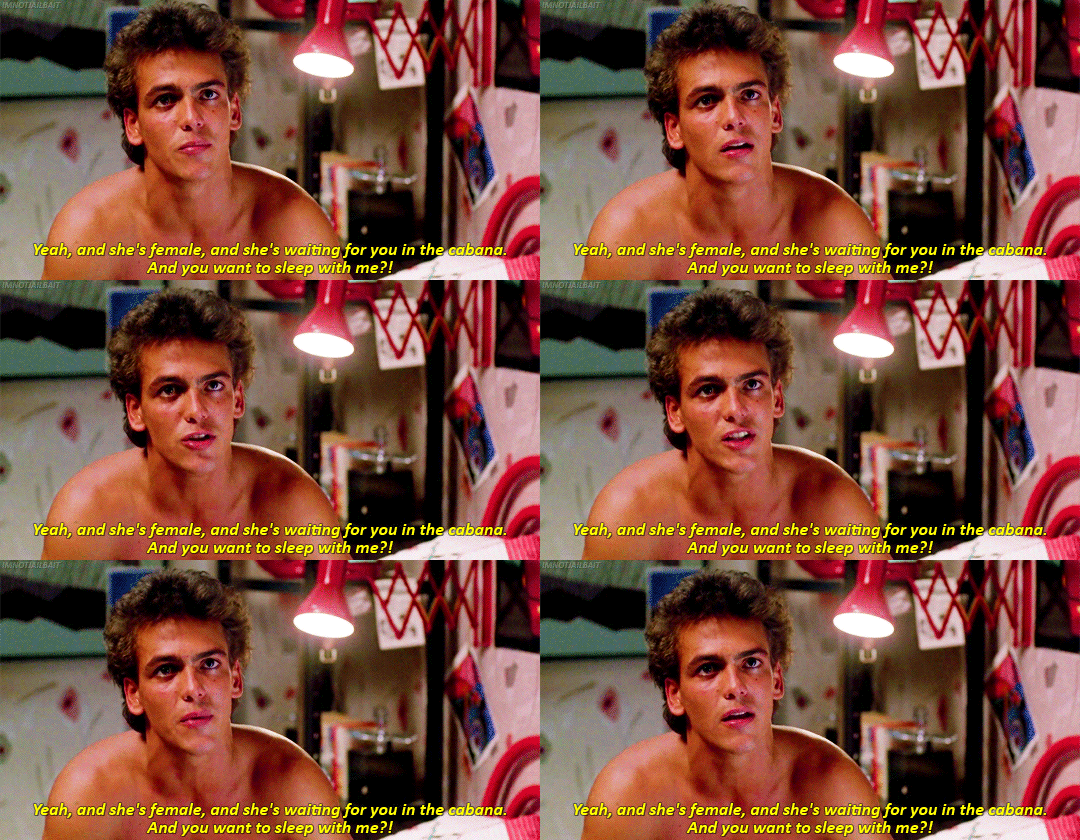
While most audience members associate their fear with Freddy Krueger. Others associated their fear with the homoerotic subtext. Throughout the film, there are numerous examples of homoerotic subtext. The most obvious one being when Jesse awakes from a nightmare and decides to go to a gay bar. While ordering a beer, coach Schneider catches him and makes him run laps around the gym as punishment. Another example of homoerotic subtext is the complication relationship between Jesse and Ron. Jesse and Ron at first despise each other. It wasn’t until they both started to receive punishment from coach Schneider that they began to bond and develop a relationship. The homoerotic subtext between Jesse and Ron is unclear, up until the scene when Lisa and Jesse attempt to have sex. Jesse is unable to finish because he freaks out. He leaves Lisa’s party and heads directly over to Ron’s house. The audience is then left to assume that Jesse is more comfortable around Ron than Lisa. All of this causes the audience to speculate that Jesse is secretly gay. Which in turn causes fear and horror. “The concepts “monster” and “homosexual” share many of the same semantic charges and arouse many of the same fears”.

Article Summary:

In the article, “The Monster and the Homosexual”, by Harry M. Benshoff, he talks about the fear of homosexuality. He mentions how a 1984 study categorized the fear of homosexuality into three categories. “(1) homosexuality as a threat to the individual – that someone you know (or you yourself) might be homosexual; (2) homosexuality as a threat to others  – homosexuals have been frequently linked in the media to child molestation, rape, and violence; (3) homosexuality as a threat to the community and other components of culture – homosexuals supposedly represent the destruction of the procreate nuclear family, traditional gender roles, and (to use a buzz phrase) “family values””. Benshoof also mentions how the AIDS crisis fueled the public’s fear of homosexuals. Comparing homosexuals to vampires, saying how “with a single mingling of blood, can infect a pure and innocent victim, transforming him or her into the living dead”. This comparison led to homosexuality being viewed by the public as monstrous.

Candyman

In the film, Candyman, directed by Bernard Rose, there are many connections that can be made between the film and Robin R. Means Coleman’s article, “Studying Blacks and Horror Films”. Throughout the film, horror is depicted through the stereotyping of African Americans. Coleman says, “Blacks have a rather unique relationship with American film’s presentation of Blacks”. American films often casting “blacks as horrific figures”.

Helen
Universal Pictures
https://www.pinterest.com/pin/566890671820031429/

The film, Candyman, focuses on Helen, a graduate student from the University of Illinois. Helen and her best friend, Bernadette, are researching urban legends. This research of urban legends leads to Helen learning about a local urban legend named Candyman. Helen becomes fascinated with the urban legend Candyman and seeks out to uncover the full story. Her pursuit to uncover the full story takes her to the notorious Cabrini-Green housing project. While investigating the Cabrini-Green housing project she uncovers how residents actually live in fear of the Candyman. Soon she would fear him and eventually become part of the urban legend herself.

Candyman
Universal Pictures
https://www.cinemablend.com/news/2469079/looks-like-the-candyman-reboot-is-taking-the-character-to-new-places

Throughout the film, the audience witnesses both stereotyping and black social issues. “To illustrate, in dubbing certain films “Blaxploitation,” this moniker is as much about exposing a category of film imbued with stereotypes of race relations, gender roles, sex and violence as it is a critique of those who created the stereotypes”. A perfect example of stereotyping in the film is when Helen visits the Cabrini-Green housing project. When she arrives she is assumed to be a cop because she is a nicely dressed white woman. This causes residents of the Cabrini-Green housing project to be hostile towards her. This hostility turns to violence when she investigates a bathroom. While investigating the site of a castration, she is assaulted by a gang leader called “Candyman”. She survives with just a black eye and reports the assault to the police. She identifies her attacker and he’s arrested. Despite being related to two other crimes the police only became interested when the crime involved a white woman. This is the perfect example of social injustice between blacks and whites. Which causes a sense of horror for the audience members.

Article Summary:

In the article, “Studying Blacks and Horror Films”, by Robin R. Means Coleman, she talks about the African American presence in American films. She says how “Blacks have a rather unique relationship with American film’s presentation of Blacks”. Coleman mentions how over time Blacks became their own film genre. “There are so many films featuring Blackness, with so many shared conventions, that Black film has become a genre in itself”. She then explains how “naming a thing is inherently dangerous in that it may further subordinate that thing”.  This is exactly what happened, and it gave rise to the term “Blaxploitation”. These Black films were often “imbued with stereotypes of race relations, gender roles, sex, and violence”. Casting “blacks as horrific figures”. Coleman mentions how there’s a difference between “Blacks in Horror Films” and “Black Horror Films”. “Blacks in Horror Films” led to stereotypical views, while “Black Horror Films” are “about Black experiences and Black cultural traditions”.

The Babadook

In the film, The Babadook, directed by Jennifer Kent there are many connections that can be made between the film and David Skal’s article, “It’s Alive, I’m Afraid”. Throughout the film, horror is depicted through the presence of a monster. “All monsters are expressions or symbols of some kind of birth process, however distorted or bizarre”. In The Babadook, the monster represents Amelia’s dark emotions brought on by being a single mother.

Amelia and Samuel
IFC Midnight
https://journalstar.com/entertainment/movies/film-review-truly-scary-the-babadook-is-best-horror-movie-in-years/article_63bca0a9-bf13-5ac5-a66e-963e94610d6b.html

Skal’s article says how “pent-up rage can be physically externalized”. This is exactly what the audience witnesses throughout the film. Amelia is a widowed mother and has a son named Samuel. Samuel constantly causes Amelia to become overwhelmed. Amelia’s grief about the loss of her husband and the stress of being a single parent becomes too much for her to handle. “Parents go through the motions of caring for the thing, but cannot cope”. This inability to cope brings about Mister Babadook.

The Babadook
IFC Midnight
https://www.storyscreenbeacon.com/post/2016/10/14/the-babadook

The Babadook torments both Amelia and her son. This torment causes Amelia to constantly comfort Samuel and reassure him that he’s safe from the Babadook. Causing Amelia to become restless and paranoid, which begins to negatively affect her mental health. The audience watches as Amelia begins to unravel. She begins to constantly have visions of the Babadook, which eventually leads to her bizarre and violent behavior.

Amelia becomes possessed by the Babadook and acts out violently towards Samuel. While attempting to strangle Samuel, Amelia is touched by Samuel’s compassion. Causing her to cast out the Babadook and to confront her dark emotions. The Babadook was more of a personal demon rather than a demonic being. The Babadook was subconsciously created by Amelia’s emotions as an outlet for the stress and grief caused by the tragic death of her husband. Once she realized she was the one in control, she was able to banish the Babadook to the shadows. Allowing herself to finally cope with the stress and grief caused by being a single mother. Amelia finally being able to cope with her emotions, allowed her and Samuel to be a happy family. Despite having a monster lurking right in their basement.

Reading Summary:

In the article “It’s Alive, I’m Afraid”, by David Skal, he says how “All monsters are expressions or symbols of some kind of birth process, however distorted or bizarre”. Skal explains the correlation between sexual reproduction and monster movies. He mentions how the “sexual revolution” during the sixties and seventies caused a sense of horror. Chemical birth control lead to a “safe” medication, called Thalidomide. Thalidomide was prescribed to pregnant women for the treatment of morning sickness. Soon resulting in the most horrific birth defects “modern medicine has ever seen”. Images of these horrific birth defects “jolted awake America’s deep-seated fascination with freaks”.  By the late sixties “a new monster myth would develop”. Causing books and films like Rosemary’s Baby to become popular in the media. Making “the reader-viewer uneasy about the prospect of parenthood”.  These monstrous children became a popular subject for horror films throughout the seventies and eighties.

The Stepfather

In the film, The Stepfather, directed by Joseph Ruben there are many connections that can be made between the film and Tony Williams’ article, “Trying to Survive on the Darker Side: 1980s Family Horror”. Throughout the film, horror is depicted through “a master-slave power relationship, one stemming from within the patriarchal family”. This meaning that the male patriarch uses his power and authority to mold his family into what he believes is the perfect family.

Jerry’s idea of the “perfect” family
https://whysoblu.com/forgotten-friday-flick-stepfather-1987/
ITC Productions

Williams’ article says that “the bourgeois family attempting to mold its subjects into acceptable gender positions”. This is exactly what Jerry tries to do throughout the film. He preyed upon broken families to live out his idea of the perfect family. Jerry used Susan and Stephanie’s recent lose of their patriarch to con his way into their family. Masking his sadistic family values behind a charismatic father figure façade. Overtime, he begins to try and mold his new family into his idea of the perfect family. His façade fools Susan but he is unable to convince and mold her daughter Stephanie with his charismatic charm.

Skeptical Stephanie
http://www.damienruinshorrormovies.com/blogs/2019/6/16/stepfather-1987
ITC Production

Stephanie is unable to be molded by Jerry’s charismatic charm. This is what ultimately leads to his demise. He is unable to cope with the fact that Stephanie doesn’t follow the “acceptable gender positions”. She goes against his family values by getting into fights and eventually getting expelled from school. He uses his charismatic charm to convince her principle to allowed her to attend school again. This causes Stephanie for the first time to actually trust Jerry. The trust between the two is shortly lived. His façade begins to unravel when Jim, Jerry’s former brother in law, starts intervening with his new life. Which causes Jerry to act out violently because he realizes that he is slowly losing control of his perfect family. Stephanie witnesses one of his violent episodes eventually becoming aware and understanding “where the danger lies”. The stress of balancing his lives and his desire to have a perfect family becomes too much for Jerry to handle. Causing him to slip up about his past in front of Susan. This slip up caused Jerry to have a psychotic break causing Susan and Stephanie to fight for their lives. This goes to show even perfect families have dark secrets.

Reading Summary:

“Trying to Survive on the Darker Side: 1980s Family Horror” by Tony Williams, talks about how the emergence of horror films containing “gory bloodbaths of promiscuous teenagers” during the 1970s led to horror films being more “complex and contradictory” during the 1980s. Williams mentions Carol Clover, using her notes to say how this new genre creates “a visible adjustment in the terms of gender representation”. Clover believes these adjustments “reveal an uncertain sense of sexual identity”. Leading to Clover arguing how contemporary horror films have an obsession with feminism, displaying masculinized female power. Clover believes that masochism is the dominant feature in horror films not sadism.

The Texas Chain Saw Massacre

In the film, The Texas Chain Saw Massacre, directed by Tobe Hooper there are many connections that can be made between the film and Tony Williams’ article “Chain Saw Massacre: The Apocalyptic Dimension”. Throughout the film, the audience witnesses a terrifying version of an apocalyptic family. This type of horror associates fear with the audience’s psyche. “The films emphasize excessive violence to the detriment of social meaning by sadistically immersing the audience in a masochistic barrage of special effects”.

The Sawyer Family(Apocalyptic Family)
https://unrealitymag.com/5-movies-that-make-your-family-seem-normal/
Vortex

Williams’ article provides the audience with an insight into an apocalyptic family horror. “Apocalyptic dimensions have histroical connections determining particular cinematic treatments of the family that revealed American horror film as a fundamental component of the national cultural tradition”. The Texas Chain Saw Massacre is the perfect example of Richard Slotkin’s violence theory. “Puritan ancestral fears finally prove themselves more powerful than Enlightenment concepts within the Declaration of Independence. Contrast emerge between western civilization’s repressive structures and demonize others in a cultural Gothic imagery”.

Importance of Family
https://bostonhassle.com/the-texas-chainsaw-massacre-1974-dir-tobe-hooper/
Vortex

The Texas Chain Saw Massacre represents Puritans worst fears. The Sawyer family resides in a slaughterhouse and practices “cannibalistic activities”. The family is seen to the outside world as worthless because their family business was made obsolete by new technology. This sense of worthlessness makes family important to the Sawyers because that’s all they have left in this world. The Sawyers take pride in the fact that as a family they practice cannibalism. They prey upon outsiders who they perceived wronged them in some way. ”Evil lies within American society and the family”.

Reading Summary:

“Trying to Survive on the Darker Side: 1980s Family Horror” by Tony Williams, talks about how the emergence of horror films containing “gory bloodbaths of promiscuous teenagers” during the 1970s led to horror films being more “complex and contradictory” during the 1980s. Williams mentions Carol Clover, using her notes to say how this new genre creates “a visible adjustment in the terms of gender representation”. Clover believes these adjustments “reveal an uncertain sense of sexual identity”. Leading to Clover arguing how contemporary horror films have an obsession with feminism, displaying masculinized female power. Clover believes that masochism is the dominant feature in horror films not sadism.

Carrie

In the film, Carrie, directed by Brian De Palma there are many connections that can be made between the film and Shelley Stamp’s article, “Horror, Femininity, and Carrie’s Monstrous Puberty”. Throughout the film, horror is depicted through Melodramatic family drama. “…the eruption of violence and sexuality into the domestic sphere through supernatural forces that invade the family home or render its inhabitants monstrous.” Vivian Sobchack calls this depiction of horror, “familiar and familial.”

Carrie’s Shower Scene
https://i-d.vice.com/en_uk/article/7xm8dq/10-bloody-important-onscreen-moments-about-menstruation
Red Bank Films

Stamp’s article says that “Carrie’s supernatural talents are a displaced eruption of the sexual repression enforced by her mother.” Carrie’s mother, Margaret, throughout the film is seen by the audience to be the monster. She neglected to inform her daughter about her maturing female body. This led to Carrie being both scared and horrified when she had her first period in the girls locker room. Unaware that she had just gotten her first period, she thought she was dying. This caused the other girls in the locker room to taunt her by throwing tampons and sanitary pads. Carrie’s introduction to womanhood was surrounded by “demons hurling tampons and abuse in a swirl of close-up fury.”

Miss Collins
http://www.scifimoviezone.com/carrie02.shtml
Red Bank Films

Carrie is given two different views on her introduction to womanhood. The first view is from her mother, who sees menstruation as both a monstrosity and a curse. The second view is from her gym teacher, Miss Collins, who sees it as “the promise of femininity”. “Carrie subsequent path to womanhood is presented as a treacherous course that must be cautiously navigated by either of the two possible routes she’s offered; the sexual repression demanded by her mother, or the promise of femininity volunteered by her gym teacher, Miss Collins.” Miss Collins offers Carrie femininity free from the sexual repression forced upon her by her mother. She teaches her to embrace her womanhood and to feel good about herself.

Despite listening to Miss Collins and embracing her femininity, Carrie succumbs to the prophecies predicted by her mother. The masquerade that she had made for herself falls apart when Chris ruins her prom by dumping pigs blood on her after she has won prom queen. This action sets up Carrie for a downward spiral using her “telekinetic wrath”. She rebels against both the views on her introduction to womanhood by eliminating both Miss Collins and her mother. The audience watches as she destroys everything she’s familiar with. Eventually eliminating herself because she sees herself as the monstrous femininity that her mother warned her about.

The Exorcist

In the film, The Exorcist, directed by William Friedkin, there are many connections that can be made between the film and Barbara Creed’s article, “Horror and the Monstrous-Feminine: An Imaginary Abjection”. Throughout the film, Regan demonstrates many acts that would be considered abject, especially for a female girl her age. “All human societies have a conception of the monstrous-feminine, of what it is about women that is shocking, terrifying, horrific, abject”. Friedkin takes this into account and uses it to create a unique take on horror.

The Priest being vomited on.
https://www.dga.org/Craft/DGAQ/All-Articles/0803-Fall-2008/Shot-to-Remember-The-Exorcist.aspx
Hoya Productions

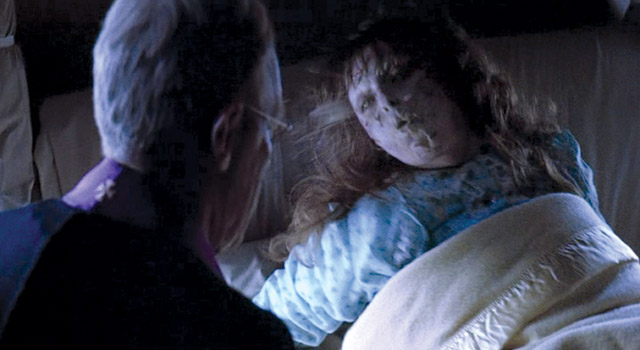
Friedkin creates this unique horror by subjecting the film’s audience to different acts that most human societies deem abject. The most reoccurring act of abjection seen throughout the film is the ejection of bodily wastes. There are numerous scenes throughout the film that use this to horrify the audience. One scene in particular that is considered especially abject is when possessed Regan projectile vomits on the priest while he’s trying to perform the exorcism. This scene connects to Creed’s article when she says “The abject can be experienced in various ways, one of which relates to biological bodily functions”. This scene is considered to be especially abject because the idea of someone vomiting on a catholic priest is considered by most to be horrifyingly wrong.

Bloody crucifix
http://www.realmoftektonikus.com/noises-in-the-attic-part-2-conclusion
Hoya Productions

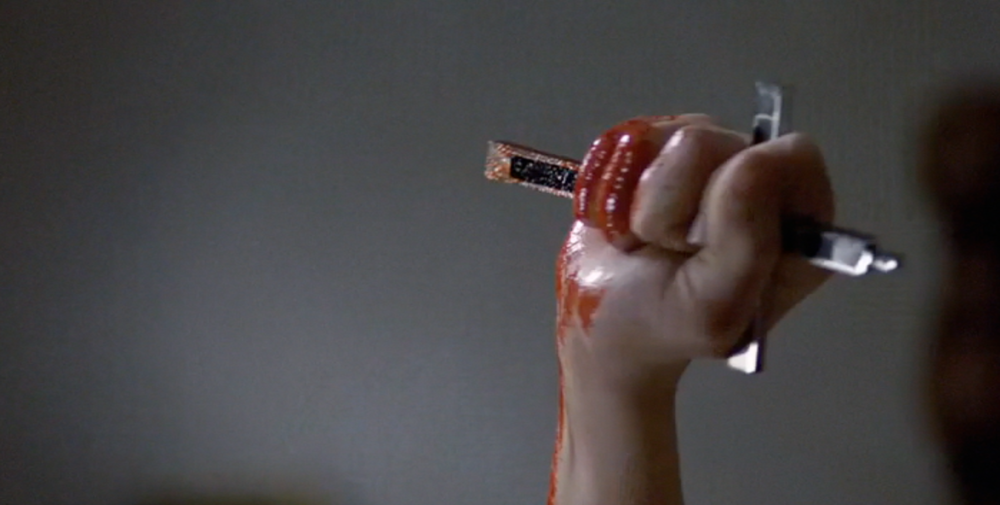
Another abject scene that the audience is subjected to is the scene when possessed Regan violently pleases herself with a crucifix. The idea of this alone is deemed horrifyingly wrong and unholy. What made this scene more abject to the audience is the fact that they witnessed Regan smear her blood on her mother’s face. This scene connects back to Creed’s article when she says, “The modern horror film often “plays” with the audience, saturating it with scenes of blood and gore…in one scene blood from her wounded genitals mingles with menstrual blood to provide one of the film’s key images of horror.” This scene is a perfect example of a women being horrifically abject.

Friedkin uses actions deemed by most human societies to be abject, to create a unique sense of horror. This film in a way created a new sense of horror. This film was more psychologically disturbing than scary for the audience. Friedkin did this by using societies’ concept of “what it is about women that is shocking, terrifying, horrific, abject” to create a film that made its audience cringe and be horrifically disturbed. This is exactly what The Exorcist made its audience do.

Scream

In the film, Scream, directed by Wes Craven, there are many similarities to the classic slasher films that Clover talks about in her article, “Her Body, Himself”. What makes Scream different from the classic slasher films that Clover talks about is that the film is perceived by the audience to be both funny and scary. Still the film follows the same outline and has the same components as a classic slasher film. This film re-invented the classic slasher film genre to make it more suitable for a modern teen audience.

Tatum crushed to death by a garage door.
http://www.trulydisturbing.com/2016/12/10/kill-week-tatum-riley/
Woods Entertainment

Although Craven tweaked the classic slasher film genre for his movie, Scream, the main components of the film are still the same. One component that was kept consistent were the victims, in Scream, the audience sees both male and female victims. The murder of the male victims were typically quick and easy, while the murder of the female victims were longer and more graphic. Two examples of this are portrayed in the film, one is when the the cameraman was quickly killed by having his throat cut, the other is when Tatum was crushed to death, while trying to escape from the killer. It was obvious to the viewer that more effort was put into the killing of female victims rather than male victims. This relates to Clover’s article when she says, “The death of a male is always swift; even if the victim grasps what is happening to him, he has no time to react or register terror…The murders of women, on the other hand, are filmed at closer range, in more graphic detail, and at greater length.”

Sidney the final girl.
https://www.abc.net.au/news/2018-10-24/sidney-prescott-in-scream-1/10419882
Woods Entertainment

Two other concepts of classic slasher films that were present in the film, were the killer and the final girl. The identity of the killer for most of the film was not made perfectly clear. It was not until the end of the movie that the audience found out that the killer was not just one person. The killers were Sidney’s boyfriend, Billy, and his friend, Stu. For most of the film the audience was made to believe that both Billy and Stu were just as much a victim as Sidney was. This type of killer is called a psycho, in Clover’s article. “the killer is an insider, a man who functions normally in the action until, at the end, his other self is revealed.” The final girl who was subjected to the full extent of the horror was Sidney. Not only did the viewers witness Sidney survive and outsmart her killers, they also witnessed her successfully kill both of her attackers. This is a perfect example of what Clover meant in her article. “She is the one who encounters the mutilated bodies of her friends and perceives the full extent of the preceding horror and of her own peril; who is chased, cornered, wounded; whom we see scream, stagger, fall, rise, and scream again.”

This film, in a way, introduced the classic slasher film genre to a more modern teen audience.

Halloween

It is clearly displayed to the audience how throughout the film, Halloween, directed by John Carpenter, that the film contains all the aspects of a slasher film. Some of the aspects being, a killer, a victim, a terrible place, and of course, a weapon. In Carol Clover’s article, “Her Body, Himself”, she talks about how all these concepts create the perfect scenario for a slasher film. “Its elements are familiar; the killer is a psychotic product of a sick family but still recognizably human; the victim is a beautiful, sexually active woman; the location is not-home, at a terrible place; the weapon is something other than a gun; the attack is registered from the victims point of view and comes with shocking suddenness.” The movie, Halloween, displays all the aspects of a slasher film.

Michael after he stabbed his sister.
https://www.filmindependent.org/blog/how-the-original-halloween-invented-the-modern-slasher-movie/
Compass International Pictures & Falcon International Productions

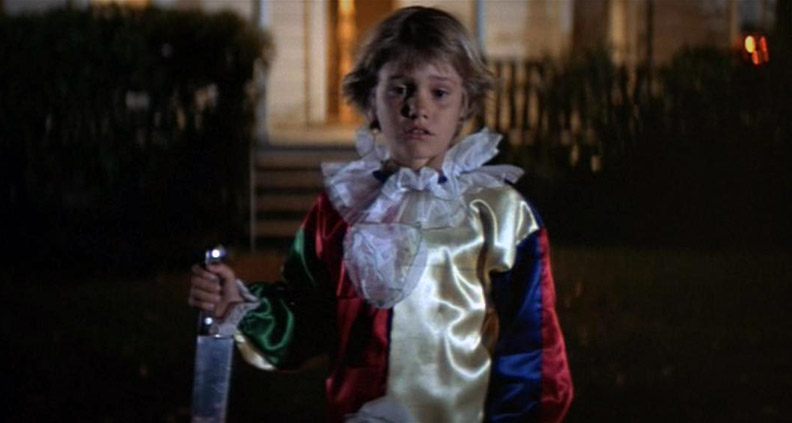
In the beginning of the film, Micheal (the killer) is seen stabbing his sister to death after he witnesses her having sex with her boyfriend. Clover says, “Michael, at the age of six, is so enraged at his sister (evidently for her sexual relations with her boyfriend) that he stabs her to death with a kitchen knife.” When Michael saw his sister engaging in these acts it triggered something in his brain. It caused him to start acting out violently towards sexual situations and young women who reminded him of sister. In someway, Michael was unable to process the fact that his sister was having sexual relations and this led to him being stuck in the same psychological mind set he was in when he stabbed his sister to death. This connects to a part of Clover’s article when she says, “… although Michael’s body has attained maturity, his mind remains frozen in infantile fury.” This is what causes him to go on his killing spree fifteen years later.

These are three of the beautiful women Michael terrorizes.
https://www.pinterest.ph/pin/830491987510041753/
Compass International Pictures & Falcon International Productions

Another aspect of slasher films that Clover talks about are the victims. She talks about how one beautiful victim has turned into a series of beautiful victims. Clover quotes Schoell saying, ” Other filmmakers figured that the only thing better than one beautiful woman being gruesomely murdered was a whole series of beautiful women being gruesomely murdered.” Even the victim’s age has changed, originally the victims were adults, now they are typically in their late teens. Slasher films also brought a new set of victims into play, the male victim. These changes can been seen throughout the film, instead of Michael going after just Laurie, he also goes after three of her teenage friends, one of them being a male victim. These changes were made to horror films to make a whole new type of horror genre, aimed towards young heterosexual males, this new horror genre became known as slasher films.

Halloween contains all the classic components of a horror film. These components were just changed a little bit to cater to the new audience that filmmakers were looking for. The new audience they were aiming for were young, heterosexual males and they used slasher films to gain their attention.

Psycho

Throughout the film, Psycho, directed by Alfred Hitchcock, it is clear how sexual fantasies and the male gaze play a big role in films, especially horror films. In the article, “Visual Pleasure and Narrative Cinema”, by Laura Mulvey, “the fascination of film is reinforced by pre-existing patterns of fascination already at work within the individual subject and the social formations that have moulded him.” This basically means that the male gaze is pre-existing and that society as well as experiences have moulded Norman Bates.

Norman Bates spying on Marian Crane through a peephole.
http://www.opticstalk.com/your-favorite-bw-movies_topic42503_page17.html
Shamley Productions

The male gaze is defined as an assumption in visual or creative arts that an audience interprets from a typical heterosexual male objectifying or sexualizing women for pleasure. This is apparent to the audience throughout most of the film. One scene, in particular, that demonstrates this behavior is when Marion Crane is undressing to get into the shower and Norman Bates spies on her through a peephole in the motel’s office. In the article, “Visual Pleasure and Narrative Cinema”, Mulvey says, “the cinema would seem to be remote from the undercover world of the surreptitious observation of an unknowing and unwilling victim.” This scene depicts that Norman Bates gets sexual gratification from watching women who visit his motel all of which are both unwilling and unknowing.

Norman Bates acting out violently.
https://ibby.com/liam-neeson-nine-inch-nails-charger-story-irrational-fears/
Shamley Productions

After the death of his mother, Norman Bates developed some sort of a split personality disorder. He has always had an abnormal and disturbing fascination with his mother, which worsened after her death. In the book, “The Dread of Difference”, Linda Williams says, “Clearly the monster’s power is one of the sexual difference from the normal male.” Norman displays two different personalities, one being his mother and the other being his actual self. Norman’s actual personality is shown a majority of the time until he starts to get sexual gratification from watching women while they are unaware of his prying eyes. This sexual gratification that Norman exhibits causes his mother’s personality to come out and take control. His mother’s personality sees these women as a threat to their relationship and acts out violently towards them. The audience first becomes aware of this violence when Norman stabs Marion while she’s showering. Norman acts out violently because of his mother’s jealousy towards these women, “She first symbolizes the castration threat by her real absence of a penis” (Mulvey, 1975).

It has been shown that the male gaze is used to increase views on films, especially horror films, because it sexualizes and objectifies women. This attracts the young heterosexual male crowd to come and watch these films; which is exactly what early horror films were trying to do. As time has evolved, objectifying and sexualizing women has become a trend in different films.

Create your own website, free on WordPress.com.Create your own website.
Start free